Induction motor vs BLDC motor
The air cooler industry is gradually shifting from traditional shaded-pole and capacitor-run induction motors toward Brushless DC (BLDC) motor technology. While the external appearance of the cooler may remain unchanged, the electrical system inside is significantly different. As a designer of BLDC cooler controllers, I have observed that most users understand the benefit of lower electricity bills but are often curious about how these systems actually work and why they are more efficient than conventional cooler motors.
Connections and working
A modern BLDC air cooler consists of three major subsystems. The first is the BLDC fan motor, which drives the cooling fan. The second is the electronic controller that converts mains power into regulated DC voltages and generates the three-phase drive signals required by the motor.
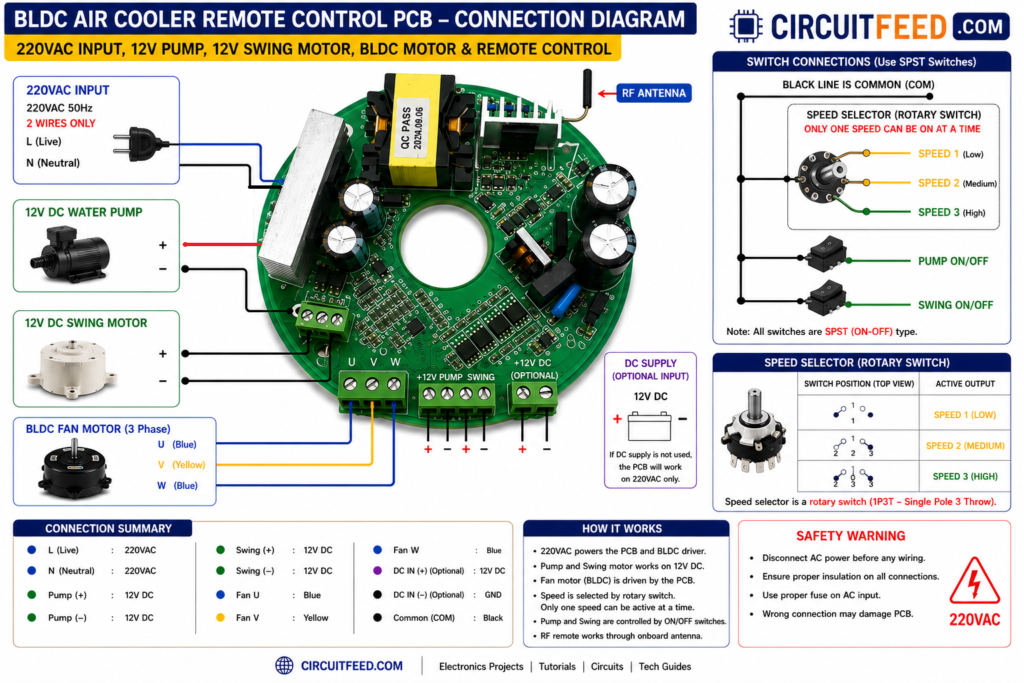
The third consists of auxiliary loads such as the water pump, swing motor, indicator LEDs, remote control receiver, and user interface switches.
Unlike solar-based DC coolers, a mains-powered BLDC cooler does not require an external 12V supply. The controller board contains its own AC-to-DC power supply section. The 220VAC input is rectified, filtered, and processed through a switching power supply circuit to generate the internal DC rails needed by the system.
The incoming AC voltage is first converted into 12V DC. This 12V DC bus is used by the motor drive section. At the same time, an isolated switching power supply generates low-voltage outputs such as 12V DC for auxiliary loads and control electronics.
Because of this onboard power supply, the water pump and swing motor can operate directly from the controller board without any external adapter or battery. The same 12V rail can also power indicator LEDs. In many practical designs, a small LED is connected in parallel with the pump output so that the user can instantly see when the pump is energized. Similarly, another LED may be connected in parallel with the swing motor output to indicate oscillation mode.
The BLDC motor itself operates very differently from a conventional induction motor. Traditional cooler motors rely on the interaction between magnetic fields generated by alternating current in the stator and induced currents in the rotor. These motors are simple and inexpensive but suffer from several efficiency limitations.
A shaded-pole motor intentionally creates a phase shift using copper shading rings. Although this design is economical, it produces weak starting torque and relatively poor efficiency. A significant amount of electrical energy is lost as heat in the stator windings and rotor.
The efficiency of an electric motor is generally expressed as:
\eta = \frac{P_{out}}{P_{in}} \times 100(P_{out}) is mechanical output power(P_{in}) is electrical input powerMany traditional cooler motors operate with efficiencies in the range of 35% to 55%, depending on load conditions and manufacturing quality. In contrast, modern BLDC motors frequently achieve efficiencies exceeding 80%.
This improvement is primarily due to electronic commutation. Instead of relying on induced rotor currents, the controller actively energizes the stator windings in a controlled sequence. The motor receives only the energy required to maintain the desired speed and torque.
The controller generates three output phases commonly labeled U, V, and W. These outputs are switched electronically using power MOSFETs. By controlling the timing of the switching sequence, the controller creates a rotating magnetic field that pulls the rotor magnets around the stator.
Since permanent magnets are used in the rotor, rotor copper losses are eliminated. This significantly reduces heating and improves efficiency.
The reduction in power consumption can be substantial. Consider a conventional cooler motor consuming 180 watts and a BLDC replacement consuming 80 watts while delivering similar airflow.
The energy saving percentage can be estimated as:
Saving = \frac{180 - 80}{180} \times 100
Saving = 55.6%
For households operating coolers throughout the summer season, this reduction can noticeably lower electricity costs.
Another important advantage is speed control. Traditional cooler motors usually depend on resistor networks or tapped windings for multiple speed settings. These methods waste energy and provide limited flexibility.
A BLDC controller uses electronic speed regulation. The user may select Speed 1, Speed 2, or Speed 3 using either a rotary selector or remote control. The controller then adjusts the motor drive algorithm rather than dissipating excess energy as heat.
Because the motor is electronically controlled, the cooler can also support features such as soft start, remote operation, memory retention, low-noise operation, and improved reliability.
In remote-controlled designs, an RF receiver integrated on the PCB receives commands from a handheld transmitter. The same controller manages fan speed, pump operation, and swing motor control. The user experiences functionality similar to modern ceiling fans while retaining the cooling benefits of an evaporative cooler.
From a maintenance perspective, BLDC systems often exhibit longer service life because there are no brushes to wear out. Lower operating temperatures also reduce stress on insulation materials and electronic components.
The growing popularity of BLDC coolers in Pakistan is largely driven by increasing electricity costs. Consumers are becoming more aware that energy-efficient appliances can recover their higher initial cost through reduced power consumption over time.
For technicians interested in upgrading existing coolers, many retrofit kits are available that include a BLDC motor and matching controller PCB. However, compatibility between motor and controller should always be verified because phase configuration, power rating, and control algorithms may differ among manufacturers.
Sources of BLDC Cooler Motors and Controllers in Pakistan
BLDC cooler motors and controller PCBs are commonly available through:
- Hall Road, Lahore
- Regal Electronics Market, Lahore
- Saddar Electronics Market, Karachi
- College Road Electronics Market, Rawalpindi
- Local appliance spare-part distributors
- Wholesale electronics importers specializing in energy-efficient appliances
Many suppliers offer complete retrofit packages containing the BLDC motor, controller PCB, remote control, and wiring harness, simplifying the conversion of conventional air coolers into modern energy-efficient systems.
As electricity prices continue to rise, BLDC technology is likely to become the standard choice for future evaporative air cooler designs due to its combination of efficiency, controllability, and long-term operating savings.